

Drake's Chair and the Golden Hind: A Story of Adventure, Intrigue, and Legacy
Tucked quietly into a corner of Oxford’s magnificent medieval Divinity School sits an object so modest that most visitors walk past it without a second glance. At first sight, it appears to be just an old wooden chair. But this is no ordinary seat—it is Drake’s Chair, crafted from salvaged timbers of one of the most famous ships in maritime history: the Golden Hind.
Sir Francis Drake, a favourite of Queen Elizabeth I, was many things—privateer, explorer, naval commander, twice Mayor of Plymouth, and the man behind “Drake’s Leat,” which first channelled drinking water from Dartmoor to Plymouth. Yet it was the astonishing voyage of the Golden Hind that propelled him into the imagination of Europe and set his name into legend.
Join me on a tour of Oxford to find out more about the city, the University and Drake’s Chair. If you want to know more about seafaring adventures then contact me about my tours of Plymouth.
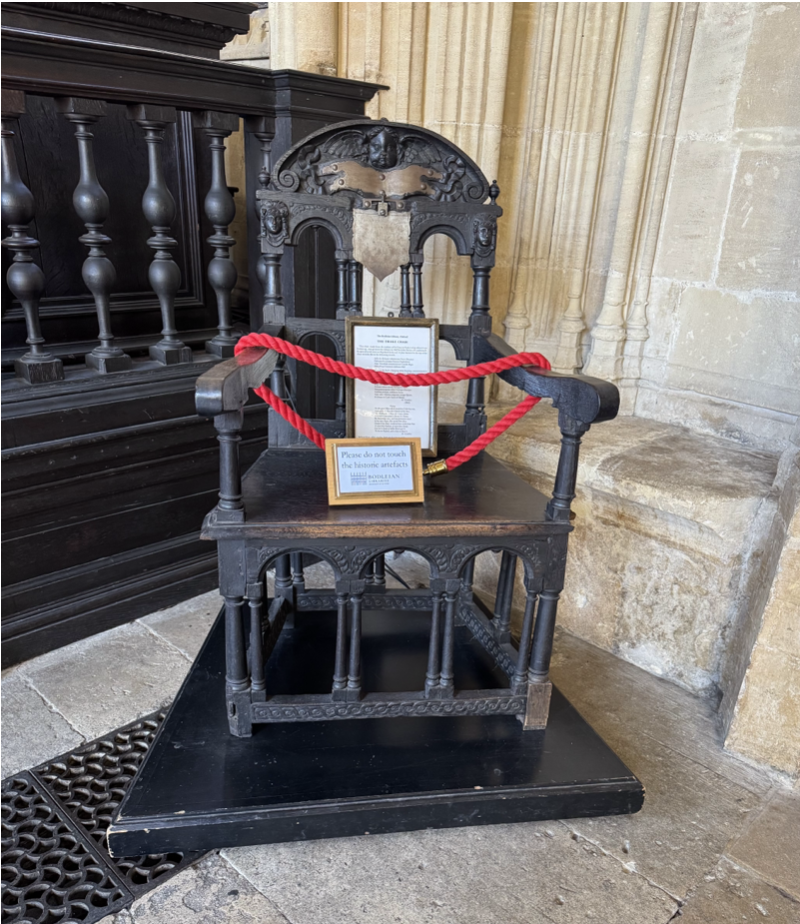
Drake’s Chair. Divinity School, Oxford.
A Secret Voyage Begins (1577)
In 1577, Drake set sail from Plymouth in a fleet of five ships led by his flagship, The Pelican. Officially, the crew believed they were bound for Alexandria on a diplomatic mission. In truth, Elizabeth I had entrusted Drake with a far more dangerous and secretive assignment.
This was an age of religious turmoil. After Elizabeth’s excommunication in 1570 by Pope Pius V, Catholic powers believed her overthrow would be an act of divine justice. Spies worked on all sides: for Elizabeth, for the Pope, and for Philip II of Spain. In such a climate, the real destination—the Spanish Main, Spain’s treasure-rich colonies in the Americas—was revealed only after it was too late for the crew to escape the voyage.
Soon after departure, Drake renamed his ship the Golden Hind in honour of one of the expedition’s backers, Sir Christopher Hatton, whose family crest featured a golden female deer.
Treasure, Storms, and Treachery
Drake’s mission was clear: intercept and seize Spanish treasure ships carrying fortunes from South America back to Spain. The venture succeeded beyond anything Elizabeth’s court had imagined. The haul was so vast that returning by the same route was impossible—Spanish ships were waiting to capture him.
Instead, Drake headed north, hoping to discover the elusive Northwest Passage. After failing to find it, he turned west, crossing the Pacific and, unknowingly, embarking on a full circumnavigation of the globe—the first by an Englishman.
Yet the voyage was far from smooth. Supplies ran low, storms were relentless, and tensions simmered on board. One of the darkest episodes involved Thomas Doughty, Drake’s friend and fellow gentleman. Accused of inciting mutiny—and even rumoured to dabble in witchcraft—Doughty was tried on Drake’s authority. In Patagonia in 1578, he was executed for treason. The event has long divided historians: was it necessary discipline, or a ruthless consolidation of command?
A Triumphant Return
In September 1580, under the cover of darkness, the Golden Hind slipped into Plymouth. She was the only ship of the original five to survive. The treasure Drake delivered was staggering—worth the equivalent of nearly £500 million today. Elizabeth’s share alone cleared the nation’s foreign debt in a single stroke.
Drake became a national hero. On the deck of the Golden Hind itself, Elizabeth I knighted him—an unprecedented honour for a man who had, essentially, committed state‑sponsored piracy.
Artefacts, Memory, and the Complexities of Legacy
Plymouth: A City Shaped by Drake
Throughout Plymouth, traces of Drake’s life and legend remain. At St Andrew’s Minster Church, bombing during the Blitz revealed graffiti drawn centuries earlier—an outline of the Golden Hind and her route around the globe, sketched by someone commemorating a feat that captured the world's imagination.
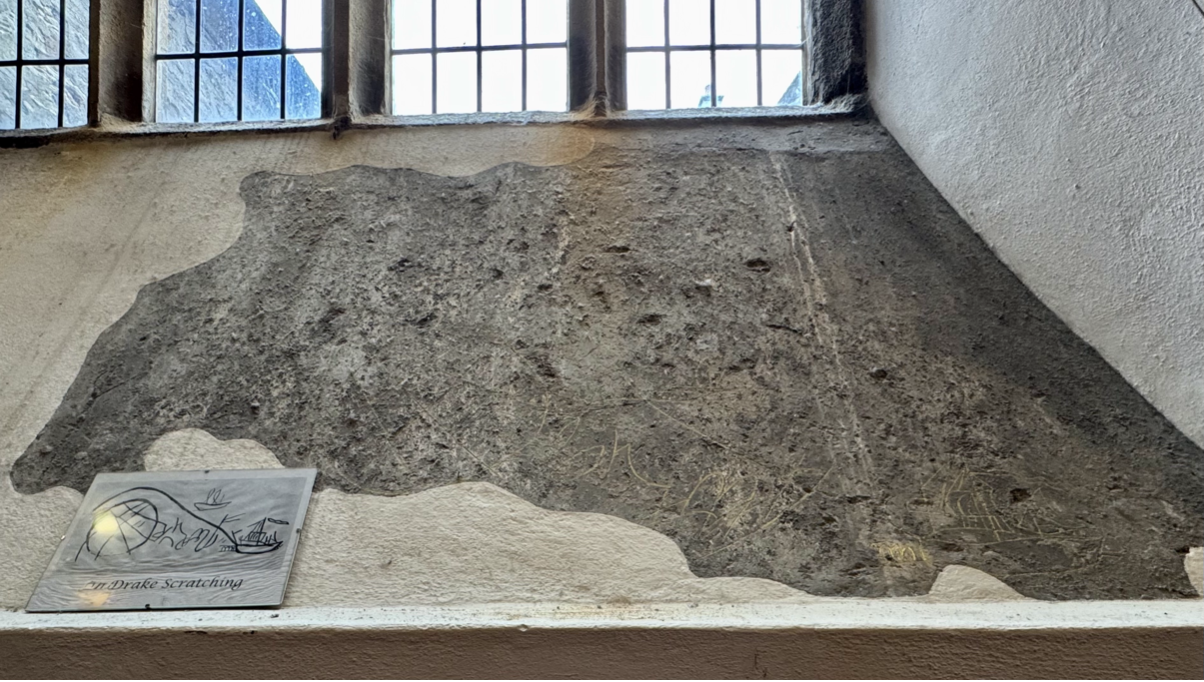
St Andrew’s Minster Church, Plymouth. Elizabethan graffiti.
At The Box, Plymouth, the “100 Journeys” exhibition explores Drake’s life in a more nuanced light. Among the displays is a photograph of the statue of Drake on Plymouth Hoe—tights, billowing shorts, lace ruff, and all. But the modern signs placed beside it, reading “Decolonise History” and “BLM”, remind us that Drake’s legacy is not straightforward. His involvement in the early transatlantic slave trade casts a long shadow, prompting important conversations about empire, exploration, and exploitation.
Drake’s Cup
Also on display is Drake’s Cup, a bright silver vessel intricately decorated with a globe—echoing the globe that stands beside his statue. These twin spheres symbolise his most celebrated achievement: sailing around the world in an age when navigation was perilous and ships barely 100 feet long ventured into oceans unknown.
A Chair That Holds a World of Stories
And so we return to the simple wooden chair in the Divinity School, Oxford. Made from the timbers of the Golden Hind, it is not just a piece of furniture—it is a relic of adventure, ambition, controversy, and human courage.
It reminds us that history is never simple. Drake was both hero and villain, explorer and aggressor, visionary and participant in darker chapters of global history. His voyages shaped England’s future, opened new worlds, and left legacies still debated today.
And all of that history sits quietly in a corner of a medieval room—waiting for the curious eye to notice.